2
THE GREAT SEATTLE FIRE
Lindsay Coughlin needed to get into the courthouse unseen. Any other building in Seattle would not have been so difficult in late fall. The city’s streets were empty of all but abandoned cars and dead leaves, shutters were pulled down over first floor windows. The traffic lights all blinked yellow. It had the uninhabited largeness of a town whose main industry had moved away.
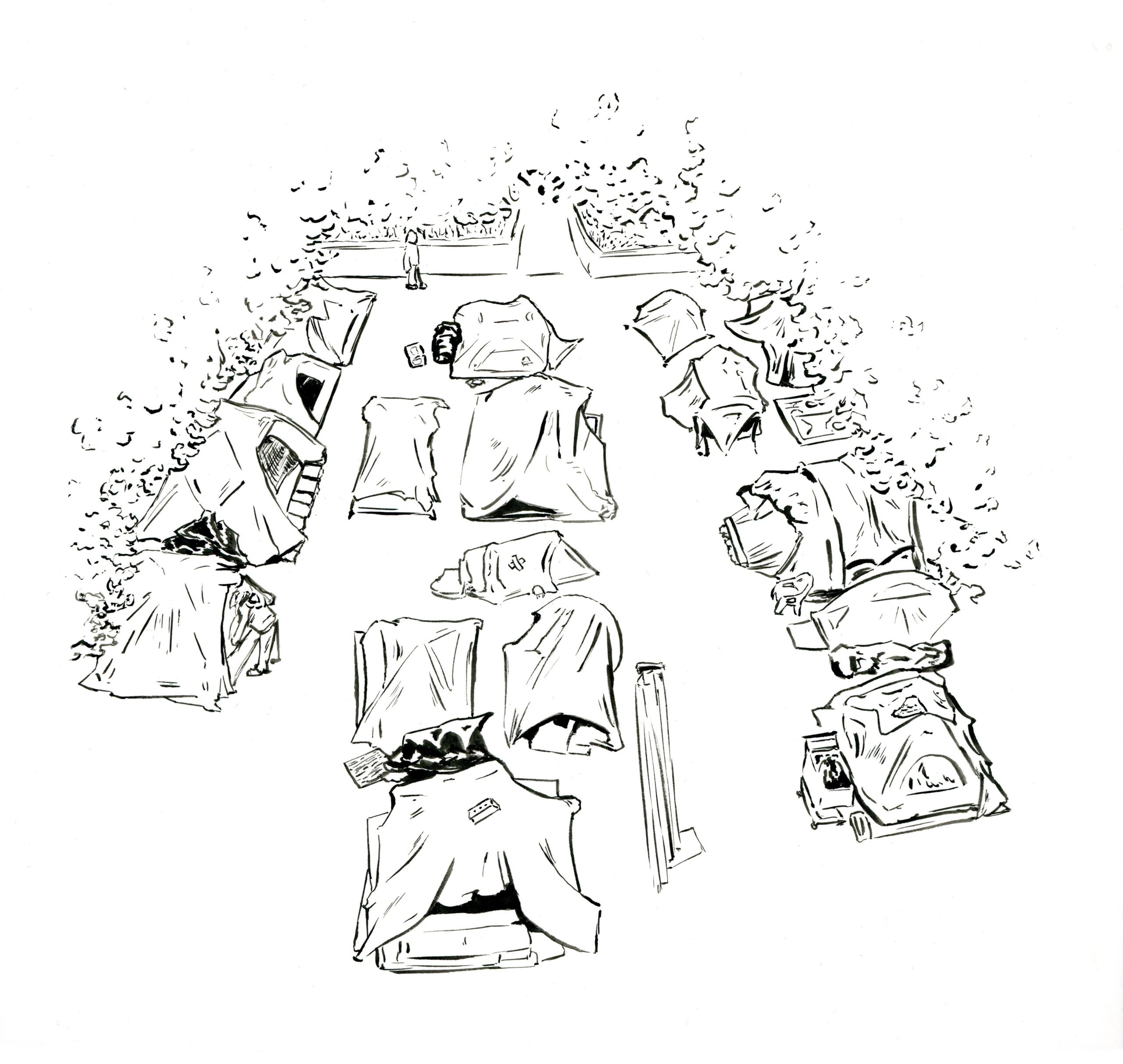
Everywhere the gray sky seemed to muffle the city, but not here, at the south end of downtown and the front line of its never-ending battle with the homeless. Stretching from the courthouse to the elevated Yesler Way where Lindsay stood, a homeless camp occupied the entire south lawn. Shabby tents staked down against the elements, fortified by blue tarps and shelter blankets, raised up out of the mud- some of them- on crude wooden platforms. This camp was not a place of work or play for them, so while the rest of Seattle drained away to the suburbs to watch their fires, they remained, standing in front of their tents or on the sidewalk below the homeless shelter across the street, chatting with their neighbors, smoking, making plans for spring. A good natured cackle rose up from a hefty woman in a wheelchair. This was their home.
From his vantage point on Yesler, he had to take a wide loop to the north to come down Fourth Ave, skirting the edge of the camp and slipping in a side door between panel trucks and the dumpster. This led down to a lower level, below the grandeur of the courthouse’s marble columns and brass elevators. Here the decor was plain, the dimly lit hallways a little grungy. He passed the radio room with banks of equipment on unfinished plywood shelves, blinking lights, a key cabinet- closed.
Next he passed a large kitchen with a six range gas stove, chest freezer, coffee rings on the cheap countertops. He pictured them there, the wintermen, huddled in their warm lodge while the world above them slept. All people hibernated, without exception, but the wintermen were those who either lied down much later or rose early each spring. They saw more of winter than anyone else, but more importantly they kept guard over the hibernators, kept them safe. At least, historically, that’s what they were supposed to do.
While Coughlin was deep in his imagining, a head poked around the corner. “Hey! What are you doing here?”
Coughlin turned to the speaker but didn’t respond. It was shockingly gorgeous woman- Chinese he thought- with black hair slicked back in an undercut.
“You’re the new guy aren’t you?”
“No, I’m… well, yeah.”
“Come on, we’re waiting on you.”
Coughlin followed her further back into the recesses of the winterhouse to somewhat of a den. The walls were wood-paneled, and a short, wide window ran along the top of the wall on one side, just peeking out at ground level to see the sidewalk. A couple thrift-store scavenged couches, easy chairs and folding chairs had been set up in the center, where the rest of the wintermen faced the unlit fireplace. There Coughlin recognized Chief Nakamura- the only winterman on the crew he’d met before- who was in the middle of addressing them.
“…so, without two of our heavy hitters, it’s going to get pretty lean by midwinter. Ah, speaking of which-” she gestured to Coughlin, “here is our newest recruit, Lindsay Coughlin.”
As Coughlin took the last fold-up chair, a dozen eyes of wintermen set on him.
“That’s Lindsay?”
From under breath he heard “Of course Lindsay’s a dude.” and turned toward it. It was a young teenage boy in the front row. He was the only child on the crew, an intern, a future winterman maybe, someone who needed to be looked after while his parents hibernated. The rest of the crew ranged in age from young adult to white-haired, men and women. What makes a winterman is a lot of genetics, and still mostly a fluke.
“Coughlin,” Chief Nakamura said, “You’re going to be shadowing Burne, here. He’s starting out in Pioneer Square.” Ahead of him, Coughlin saw a thick, strong hand shoot up from behind a wingback chair, and made a note of the hairiness and gaudy class ring. “Welcome to the crew.”
The chief was silent a moment, studying the notes in her hand for the briefing. She was a Japanese woman in her fifties, with a tanned and slightly wrinkled face. The hands that held the notes were calloused and dirty. When she spoke, it was without an accent but very careful and exact. “You should know,” the chief said, “winter in Seattle isn’t as cold as other places this far north, but it is dark. As dark as you are going to find south of Alaska. Even in the day you won’t see the sun, it hangs so low in the sky and behind clouds. At night there are no stars. No lights in windows except ours.
“And winter is when we get our rain. My husband, he doesn’t understand this, but as soon as he lays his head down on Embernacht, that’s when it starts. Right outside their bedrooms. Pinging against their windows all winter- that constant drizzle. But we know. We spend the winter huddled under hoods, tramping down alleys with just a single lantern lit in the entire city. I don’t blame Jensen and Ramos for leaving. It’s wet, and dark, and lonely.”
Nakamura paused, looking sternly into Coughlin. “At least, you better hope it’s lonely.”
Coughlin was standing in the entrance alcove and smoking when Burne came out to meet him, and he watched those same thick, hairy hands pull on the trademark hooded trench of the Seattle wintermen. Seeing him fully now, he was a stocky and strong man, with a thick but well-trimmed beard and receding hair. He gestured to Coughlin. “That all you got?”
Coughlin looked down at his clothes: a scuffed brown leather jacket, Kirkland blue jeans and brandless white sneakers. “Oh, yeah. Chief said he could find something for me today?”
“Hmpf. Alright. Well, let me show you around, I guess.” He took off downhill between the tents and the shelter, and Coughlin followed, compulsively scanning over each shoulder. “You been in Seattle long?”
“Well, about a year and a half.”
Burne turned and glared at him. “You were here last winter? What the hell else were you doing that was so important?”
Coughlin lost himself for a moment, remembering the previous winter. Hunger. Fear. And freezing water. “Oh, well, you know, I… I had trouble with the application process. Paperwork stuff.”
“Seriously? God damn, as much as we need more wintermen and they still let some file sit on someone’s desk for a whole winter.” As they approached Second Ave, and the small park on the side of the street, Burne gestured around him. “So you’ve seen Pioneer Square, then?”
“I’ve… spent some time here.”
“This is the junkie capitol of Seattle. There’s so much meth flowing here the sewers are tweaking.” Burne approached an old-fashioned wrought iron and glass bus stop where a lump had amassed against the wall. Between the wall and a pile of rolling luggage, and under the unmistakable blankets of the homeless shelter which resemble lint cleared out of the dryer, barely visible, was the white-haired head of an old black man.
“Hey.” Burne called. “Hello? Come on. Hi there.”
“Whas…whassup?” The man slurred.
“Hi there. What are you doing here. What’s going on.”
“I’m… I’m waitin’ for the bus.”
“Bullshit. The bus stopped running.”
“Nuh uh. There’s one more bus. Um just waitin’ for the bus.”
“Don’t lie to me. You’re going to hibernate.”
“Nuh uh.”
“Look at you, you’re nested under a shelter blanket. Take the blanket off.”
“S’cold.”
“Take the blanket off. Get up. Get up. Get up now.” Burne pecked at the man. “You’re not taking the bus anywhere.”
“Hey man,” Coughlin grabbed Burne’s arm. “What are you doing?
Burne shook him off. “You want him to freeze to death out here? Look at him!” Burne turned back to the homeless man. “Go up the street and check in at the shelter.”
“S’no room there.”
“They’ll figure it out. That’s where you have to go. You’re not hibernating at a bus stop. Go. I’m coming back through here, I better not see you.”
The man started cursing under his breath as he shuffled off. Burne resumed their walk, now to the south. He was quiet for a minute before turning to Coughlin. “I’m not mad, but you might not ever want to grab my arm like that again.”
“Sorry.” Coughlin muttered. “But was that really necessary?”
“Every year they try it right out on the streets. No tent, no sleeping bag. And of course they don’t make it. Of course they don’t. But they don’t want to be in the shelter. And every year spring shift carts off their corpses and thinks we don’t care if they live or die. I tell you, I’d lock them in at that shelter if I could.”
Burne led Coughlin into Occidental Square, a dark, brick-paved square shaded by trees, with a western wall covered in ivy, and totem poles guarding either side. People were gathered here too, though not as much as on Third Ave, and quite a few looked like they had nested under shelter blankets, in crevices beside rolling luggage or black garbage bags.
“This is it.” Burne gestured. “This is the hub. Ninety percent of problems we get in the winter come from here, and I can’t clear them all out. This is the crotch of Seattle, I’m guessing that’s why the chief has you here giving me a hand.”
Coughlin winced at this description. “Well, it’s pretty. I mean, the architecture is nice.”
“Oh yeah. It’s a real shame that they have to ruin this place, but that’s what they get for having Union Gospel right over there. Hey, do you know why it looks like this, all old brick?”
Coughlin shook his head.
Burne continued walking as he explained. “Oh, they tell this story in school all the time here, I’m surprised you haven’t heard it somewhere. See, back in the day, when this was just a frontier town, the main industry was lumber. So since they had so much it only made sense to build the entire town out of it. And not here, either, down there.” Burne pointed straight down.
“They built the town so low in the mud, in the tidal flats, that the water would come in and flood the streets. There’s a story where one guy saw a horse drown right in the middle of the street. Anyway, all wood. And there’s an apprentice working in a cabinet shop, making wooden furniture. Well, he’s heating old-fashioned glue over a burner and he knocks it over, sets the entire shop on fire. And the fire spreads next door to the liquor store. Then another store down to the gun and ammo shop.
“Like I said, the entire town is wood, so the fire had everywhere to go. The fire department comes on scene and they start plugging in all their firehoses, but the problem is even the pipes were made out of wood. The water pipes burned down. And every time they connect another hose, the water pressure gets lower and lower. And eventually they’re just standing there with these limp hoses and water just dribbling out the end.”
Coughlin tried to cover his smirk.
“So the entire town is burning down, and you know what the townspeople did? They startled heckling the firefighters.”
“Oh my God.” Coughlin laughed.
“Yeah, they started making fun of them. So the firefighters, these guys were all volunteers, they just said ‘screw it.’ ” Burne held up middle fingers on both hands. “ ‘Enjoy your ashes, assholes.’ Fire took all of downtown. Some people had to escape on ships before the wharf burned down.”
“A lot of people died?”
“Not in the fire. They decided to rebuild the town in brick so it wouldn’t burn again. Made bricks from the mud right down in Georgetown. And they had to raise up the entire town to get it out of the mud. The problem was they didn’t have enough time for all that before winter. Some people headed out to Portland or Vancouver to hibernate there, but a lot of people tried to ride it out in quick shanty towns or makeshift emergency shelters. With all the wreckage, the mud, the overcrowding and shabby shelters, they were prime conditions for an outbreak of bedfish.”
“Jesus.”
“Nothing to do with it. Hundreds died. Eaten alive while they hibernated.”
“The wintermen?”
“I think some left, or else it was still a small town. Either way, there was only one winterman left that could do a through-winter, and that was Jacob Turner. He didn’t notice them until midway through the season, and by then a lot of the bedfish were the size of large dogs. They just keep eating, and growing. He tried to wake the townspeople to warn them, but everyone he woke died of shock from getting yanked out of hibernation too early. So he tried to fight them all off himself.
“There were too many for him of course, but he still tried. Their main nest was in one of the large emergency shelters. He had to set explosives around and detonate it.”
“People were still inside?”
“Yeah. Killed dozens to save… thousands. But still he had to keep fighting them off and standing watch, alone, the rest of the winter. Of course, when everyone woke in spring they saw all the destruction that was caused- shelters burned down, loved ones eaten alive, or else dead in bed where Jacob Turner had woken them. A lot of people had died. Something like that, they’re going to look for a fall guy. So they dragged the poor guy out in front of a court and put him on trial. I mean, ultimately the ruling was that he wasn’t responsible for the people that had died in the course of trying to stem the outbreak. But the outbreak itself they blamed on him since he was the winterman. Although I don’t know how he could have stopped it. They whipped him in the town square. For dereliction of duty.”
Coughlin’s face screwed up in confusion. “They didn’t- I mean he saved them, though?”
“Well that’s Seattle for you. The most ungrateful town on earth. Long as they don’t whip us I guess we can take it in stride.”
Skeleton Crew 2: The Great Seattle Fire